The Neck: Frets, Scale Length and the Truss Rod
The neck is where you choose notes, and the frets are what make a guitar a guitar rather than a violin. A fret is a shaped metal wire set into the fingerboard. You do not press the string onto the wood; you press it just behind a fret so the string rests on the fret's crown. That metal edge becomes the new end of the vibrating string, which is why fretted notes are consistent — the pitch comes from the fret's position, not from exactly where your finger landed.

The spacing is not arbitrary and it is not evenly spread. Each fret sits closer to the next than the last, following a fixed ratio: every fret shortens the remaining string by about 5.6 percent, which is a semitone in equal temperament. Luthiers used to work it out as the rule of eighteen — measure the remaining length, divide by roughly 17.8, and that is where the next fret goes.
The consequence you can hear is at the twelfth fret. Twelve semitones is an octave, and an octave means exactly half the string length, so the twelfth fret sits precisely halfway between the nut and the saddle. Play this and listen.
The twelfth fret is the halfway point
Pluck the open sixth string, then the same string at the twelfth fret. Same note, one octave higher, because you just halved the string.
e
B
G
D
A
E
-----------------|
-----------------|
-----------------|
-----------------|
-----------------|
--0-----------12-|
The full length between nut and saddle is the scale length, and different makers chose different ones. Fender settled on 25.5 inches, Gibson on 24.75. It is a small difference with real consequences: the longer scale needs more tension to reach the same pitch, so it feels tighter under the fingers and sounds a little brighter and tighter in the low end. The shorter scale feels slinkier and bends more easily. Neither is better; they just feel different, and players develop strong preferences.
Inside the neck, invisibly, is a steel rod. Six steel strings pull the neck into a forward bow, and wood moves with humidity and season besides. Gibson patented the adjustable truss rod in the early 1920s, and it changed what necks could be: a rod that counteracts string pull lets a neck be slim and still stable. Turn its nut and the neck bends very slightly, setting the amount of relief — the tiny amount of forward curve a neck needs so strings do not buzz.

Where the neck meets the body matters too. Gibson traditionally glues the neck in, a set neck. Fender bolted it on, which in 1950 was a manufacturing decision — necks could be made separately and swapped if damaged — and is still standard. Some guitars run a single piece of wood the whole length, a neck-through. Players argue endlessly about the tonal differences; what is not arguable is that a bolt-on is far easier to repair.
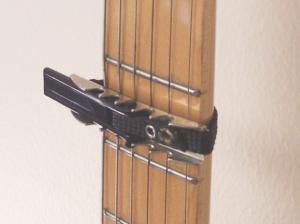
One last neck part, and it is removable: the capo. A capo clamps across the strings and becomes a temporary nut, shortening every string equally. It does not change the shapes you play, it changes what key those shapes sound in.
Capo Transposer
Work out what a capo does to your key: put the capo at a fret and see which chord shapes produce which chords.
Fretboard Note Trainer
And to get the fretboard itself under your fingers, drill note names against the clock.